

Undergraduate Programme
For Women & Men
Duration: 4 Years
Chemistry is a broad field within the natural sciences, focused on matter at the atomic and molecular levels. It examines the properties of substances, the transformations they undergo, and the natural laws that govern these processes. Often called the central science, it intersects with fields such as physics, biology, environmental science, and materials science. Chemists play a crucial role in technological progress, healthcare improvements, and the enhancement of our understanding of the natural world.
The B.S. (Hons.) / (Hons. with Research) in Chemistry programme at SSSIHL equips students with a comprehensive understanding of core chemistry concepts.
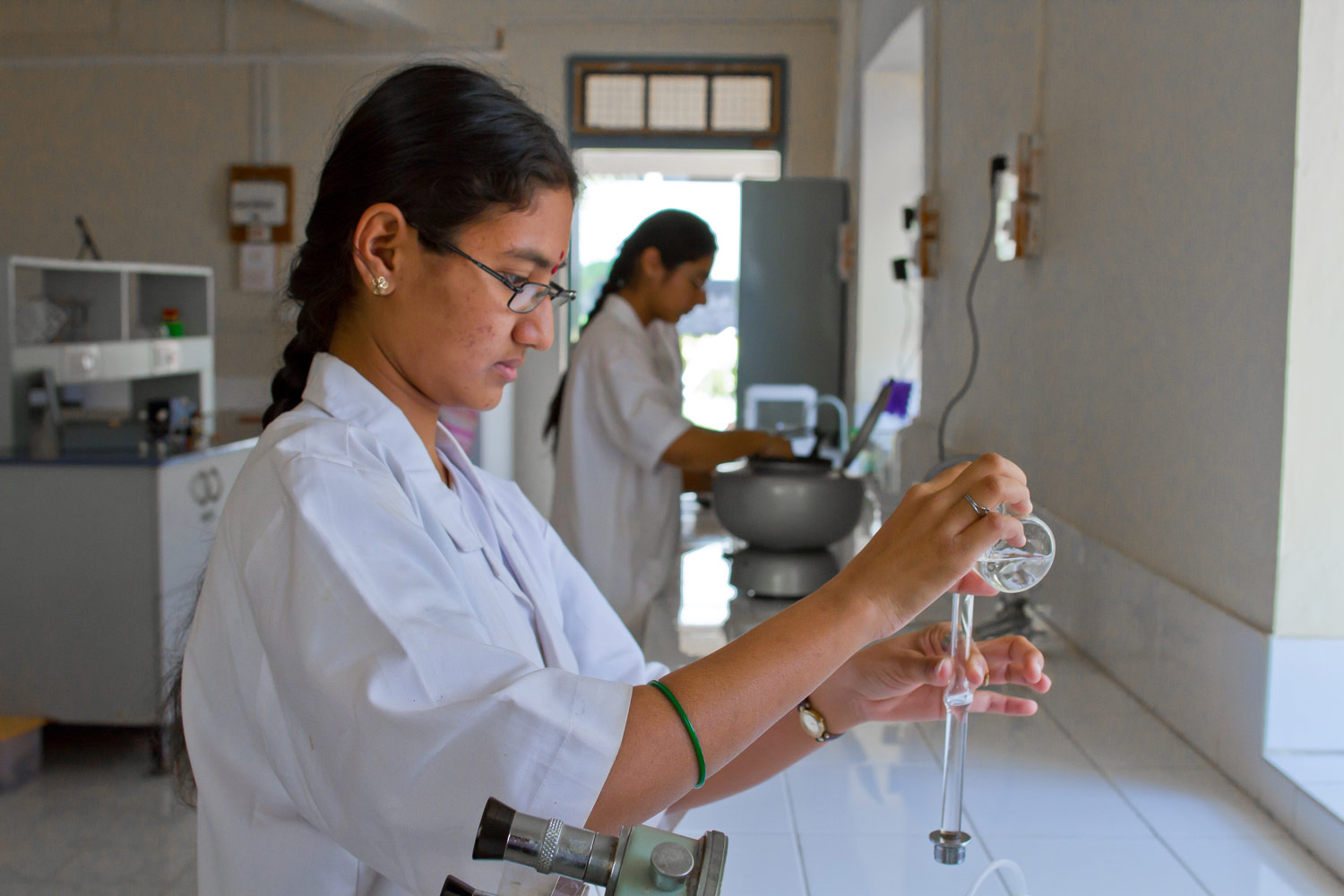
The curriculum provides a firm scientific grounding in the methods and techniques used in academic research and advanced industrial processes. Theoretical coursework is complemented by meticulously designed laboratory experiments in well-equipped facilities.
During Year 1 (Semesters 1 and 2), in addition to core Chemistry courses, students will pursue four interdisciplinary courses (equivalent to 16 credits) in either of the subjects below:
– Mathematics
– Physics
– Biosciences and Biotechnology
The first three years of study (Semesters 1-6) provide in-depth coverage of various essential aspects of chemistry through courses in Organic, Inorganic, Physical and Analytical Chemistry, laying a strong foundation for further specialization.
Specializations
In Year 4 (Semesters 7 and 8), B.S. (Hons.) students have the opportunity to tailor their programme by choosing a specialization in any one of the following three areas:
- Organic, Medicinal Chemistry and Drug Design
- Chemistry of Materials for Sustainability
- Analytical Chemistry and Instrumentation Techniques
MINOR
Additionally, in Years 2, 3 and 4 (Semesters 3-8), students are required to take Minor courses (16 credits) in any subjects from the following domains:
- Biosciences and Biotechnology
- Food Products and Processing
- Data Science
- Physics
- Mathematics
If all 16 credits are from specific subjects within a single domain, the student earns a minor in that domain.
CAREER OPTIONS
The programme equips graduates with a strong foundation for careers in research and development, quality assurance, environmental science, pharmaceuticals, education, materials research, and other sectors that value analytical and scientific expertise.
Additionally, students develop proficiency in computer programming and computational chemistry through five dedicated skill-enhancement courses. Furthermore, five ability-enhancement courses hone their communication skills, ensuring their success across diverse professional settings.
B.S. (Hons.) in Chemistry
For students who complete a 4-year (8-semester) programme of study.
B.S. (Hons. with Research) in Chemistry
For students who secure a CGPA of 7.5 or more after the first six semesters (3 years of study) and opt to pursue research during the fourth year.
Entry & Exit options as per NEP 2020 Policy.
Further Academic Options at SSSIHL
Note: Programmes are subject to change at any time without prior notice
Following their 4-year undergraduate degree, successful graduates have the following options if they choose to continue their studies at SSSIHL:
M.S. programme (1-year) – 2027 onwards
For students who complete a 4-year B.S. (Hons.) with CGPA of 7.5 or more or B.S. (Hons. with Research) in Chemistry
Programme choices: Chemistry of Advanced Materials or Organic, Medicinal Chemistry and Drug Design or Analytical Chemistry and Instrumental Techniques
Ph.D. programme
For students who complete a 4-year B.S. (Hons. with Research) in Chemistry
M.B.A. programme
For students who complete a 3-year B.Sc. or 4-year B.S. (Hons.) / B.S. (Hons. with Research) in Chemistry
- 10+2 years of schooling from a recognized board (CBSE or equivalent)
- Either passed or appeared for Final exams at XII level before Admissions. If not appeared for XII Standard exams, X and XI Standard marks will be considered
- Consistent academic performance of 60% aggregate marks in X and/or XII Standard
- Age: Preferably below 19 years as of 30th June in the year of admission
YEAR 1
Semester 1
Chemistry: Principles of Structure and Bonding
Chemistry: Laboratory Course in General Chemistry
Computer Science: Python Programming – I / Essential Laboratory Skills in Chemistry
Awareness Course I: Sai Education for Transformation (Based on Bhagawan Baba’s Life and Teachings)
Interdisciplinary Minor Courses (any two theory courses with lab practical – where applicable)
Mathematics: Differential Calculus
Physics: Analog and Digital Electronics
Physics: Practical – Electronics Laboratory
Biosciences: Animal Diversity and Evolution
Biosciences: Cell Biology
Biosciences: Practical – Animal Diversity
Biosciences: Practical – Cell Biology
Semester 2
Chemistry: Equilibria in Chemistry
Chemistry: Laboratory Course in Titrimetry and Equilibria
Computer Science: Python Programming – II / IT skills for Chemists
Awareness Course II: Unity of Religions
Interdisciplinary Minor Courses (any two theory courses with lab practical – where applicable)
Mathematics: Integral Calculus
Physics: Introductory Mechanics
Physics: Practical – Mechanics Laboratory
Biosciences: Plant Diversity and Evolution
Biosciences: Microbiology
Biosciences: Practical – Plant Diversity
Biosciences: Practical – Microbiology
YEAR 2
Semester 3
Chemistry of Elements
Qualitative Inorganic Analysis
Fundamentals in Organic Chemistry
Laboratory Course in Basic Techniques in Organic Chemistry
Computational Techniques in Chemistry – I
Minor Course
Awareness Course III: Study of Classics I – Ramakatha Rasavahini
Semester 4
Coordination Chemistry
Laboratory Course in Synthesis and Analysis of Coordination Compounds
Structure and Reactivity in Organic Chemistry
Laboratory Course in Functional Group Analysis and Structural Aspects
Chemical Thermodynamics
Computational Techniques in Chemistry – II
Minor Course
Awareness Course IV: Study of Classics II – Bhagavatha Vahini
YEAR 3
Semester 5
Solid State Chemistry
Applications of Equilibria, Kinetics and Surface Chemistry
Laboratory Course in Equilibria, Kinetics and Surface Chemistry
Synthetic Organic Chemistry
Laboratory Course in Synthetic Organic Chemistry
Skills in Scientific communication
Minor Course
Awareness Course V: Ethos and Values for the Changing World
Semester 6
Characterization Techniques for Organic Compounds
Analytical Chemistry
Laboratory Course in Analytical Chemistry
Electrochemistry
Laboratory Course in Electrochemistry
Introduction to Quantum Chemistry
Chemistry of Biological Molecules
Minor Course
Awareness Course VI: Life and its Quest
YEAR 4
Semester 7
B.S. (Hons.) Courses:
Elective – I
Elective – II
Elective – III
Elective – IV
Research Methodology
Project
Awareness Course VII: Education for Life
B.S. (Hons. with Research) Courses:
Elective – I
Elective – II
Elective – III
Elective – IV
Research Methodology
Research Project
Awareness Course VII: Education for Life
Semester 8
B.S. (Hons.) Courses:
Elective – I
Elective – II
Laboratory course based on specialisation
Project
Awareness Course VIII: God, Society and Man
B.S. (Hons. with Research) Courses:
Elective – I
Research Project
Awareness Course VIII: God, Society and Man