
Identifying the Issue
- Conventional solid electrolytes suffer from low room-temperature ionic conductivity and require high sintering temperatures, limiting the performance and safety of all-solid-state Li-ion batteries.
- Most oxide electrolytes degrade in air/moisture, creating major hurdles for practical deployment in electric vehicles and renewable energy storage
Objective of the Research
- To develop a low-temperature V₂O₅-doped LiTa₂PO₈ solid electrolyte with significantly enhanced ionic conductivity
- To harness the beneficial effect of ambient air exposure for improved grain-boundary transport
Who should read this?
Battery researchers, solid-state electrolyte developers, materials scientists, electric vehicle manufacturers, renewable energy storage companies, and R&D teams working on next-generation Li-ion batteries (India and global)
Solution
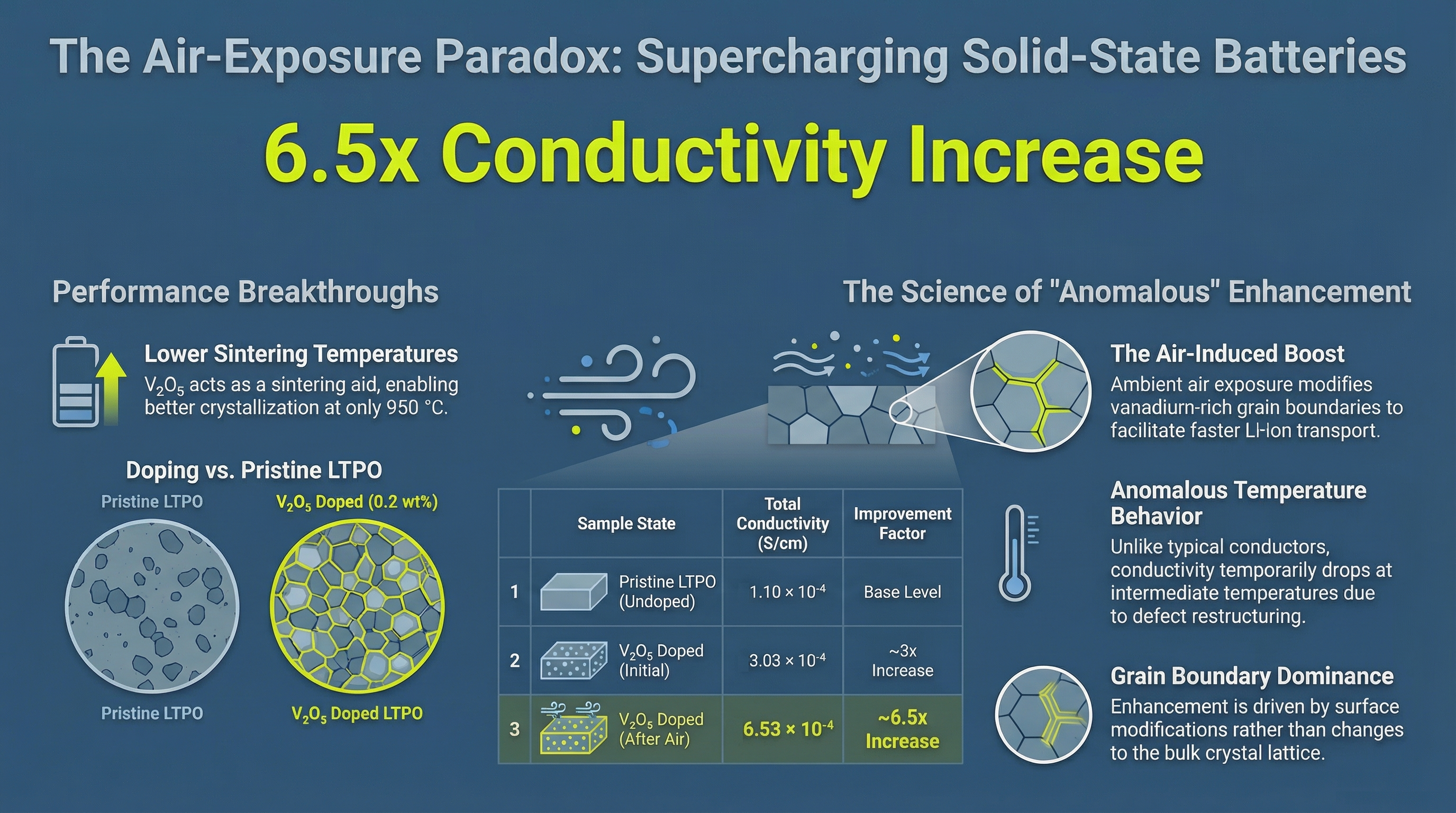
Researchers at the Department of Physics, SSSIHL, have successfully engineered a V₂O₅-doped LiTa₂PO₈ (LTPO) solid electrolyte using a simple, low-temperature solid-state route. Adding just 0.2 wt% V₂O₅ and sintering at 950 °C (100 °C lower than pristine LTPO) triples the room-temperature total ionic conductivity from 1.10 × 10⁻⁴ S/cm (undoped) to 3.03 × 10⁻⁴ S/cm. Remarkably, after only 3–4 days of ambient air exposure, the conductivity further surges to 6.53 × 10⁻⁴ S/cm — a 6.5-fold improvement over undoped LTPO.
Detailed impedance, SEM-EDS, and temperature-dependent studies reveal that vanadium preferentially segregates at grain boundaries, creating a vanadium-rich phase. Ambient moisture adsorption at these boundaries dramatically lowers grain-boundary resistance, producing the first-reported air-induced conductivity enhancement in LTPO systems. The material also exhibits anomalous (non-Arrhenius) temperature dependence linked to dynamic grain-boundary modifications.
Key Features and Benefits
- Achieves 6.5× higher room-temperature ionic conductivity after simple air exposure
- Reduces sintering temperature by 100 °C, lowering energy consumption and processing cost
- Converts a traditionally detrimental air-exposure effect into a performance-enhancing feature
- Improves both grain and grain-boundary transport without compromising structural stability
- Offers a scalable, low-cost route toward high-performance oxide solid electrolytes
Impact
- Enables safer, higher-energy-density all-solid-state Li-ion batteries for EVs and grid storage
- 5× conductivity boost brings LTPO closer to the commercial viability
- Lower sintering temperature reduces manufacturing energy use and equipment wear
- Air-induced enhancement simplifies handling and storage protocols for large-scale production
- Opens new design strategies for grain-boundary engineering in oxide electrolyte
Team
- Krisanta Rai – DST-INSPIRE Fellow
- Dr. Swarup Kundu – Assistant Professor & Corresponding Author
Title of paper: “Air-induced enhancement and anomalous temperature dependence of ionic conductivity in V₂O₅-doped LiTa₂PO₈ samples”
Journal: Journal of Alloys and Compounds (Elsevier) Published: 24 March 2026
Read Paper Here: https://doi.org/10.1016/j.jallcom.2026.187593