

Undergraduate Programme
For Women
Duration: 4 Years
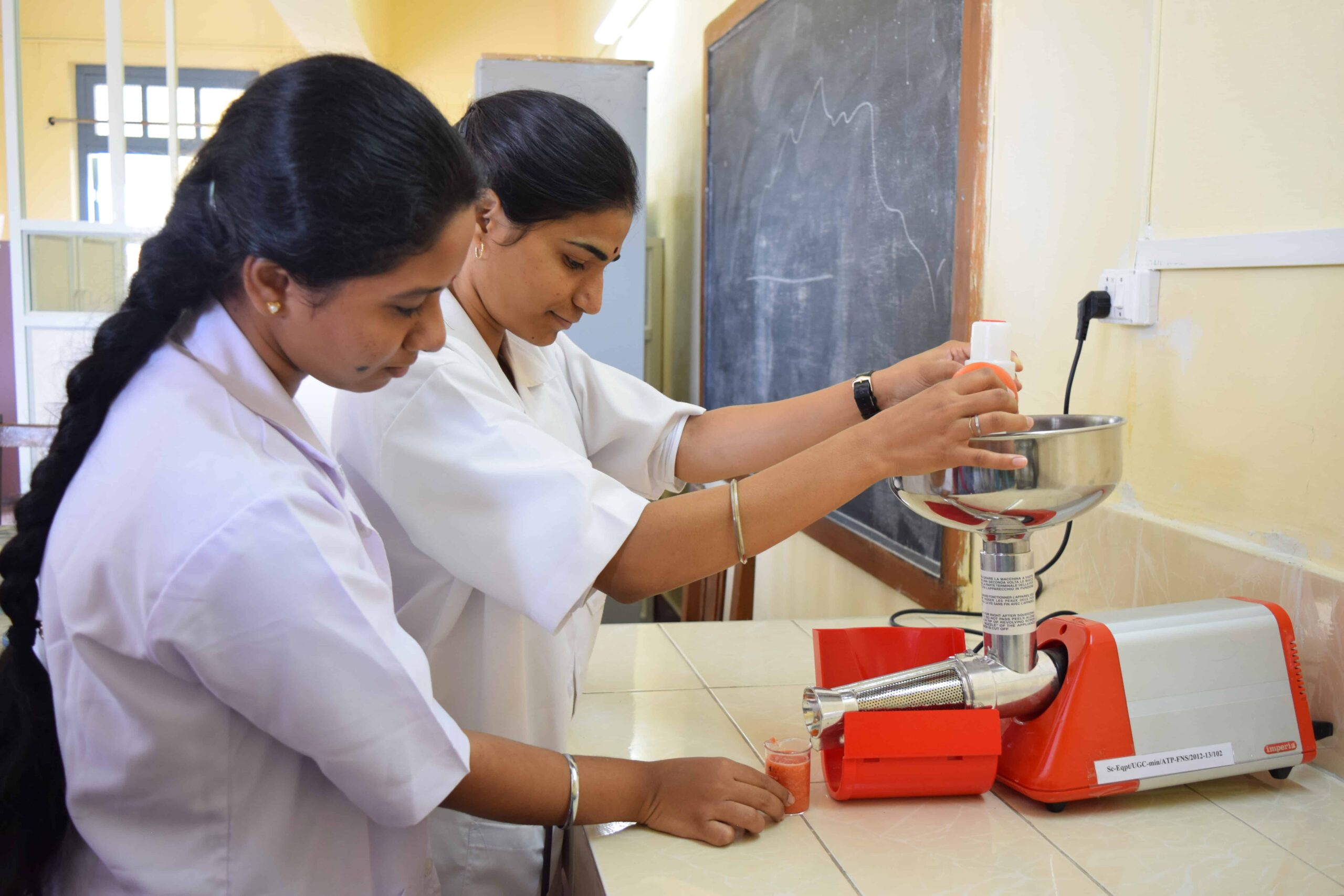
Food and Nutritional Sciences is a multidisciplinary programme comprising two core specialisations – Nutrition and Food Technology. Nutrition examines the physiological and metabolic effects of nutrients on human health, while Food Technology addresses food composition, processing and safety to ensure effective nutrient delivery and promote health and well-being. The programme encompasses core domains, including food science, nutritional science, dietetics, food processing, preservation and food safety.
Professionals in Nutrition and Dietetics play a critical role in promoting individual and public health by bridging the gap between food and its impact on the human body. They are responsible for positively influencing human health and disease prevention, and for translating scientific evidence into dietary interventions that improve quality of life at both the individual and population levels.
Food technology specialists use their expertise in food processing, innovation, and preservation to create safe, wholesome food products that leverage new technologies. Focused exposure to fruit and vegetable, dairy, and grain science technologies builds a strong foundation in handling and value addition for diverse food commodities, preparing students for careers in the food sector and for entrepreneurial ventures.
This comprehensive programme spans a broad range of fields. The degree offers numerous career opportunities and meets the growing demand for specialised knowledge. The curriculum emphasises a deep understanding of theoretical concepts and practical skills across subjects, both of which are vital for success in the healthcare sector and industry.
The programme provides comprehensive academic training in nutrition and dietetics, food components, food processing, and food product design and development, along with allied disciplines such as physiology, microbiology, biochemistry and quality assurance. The broad, integrated curriculum offers students a strong blend of scientific knowledge and technical skills, preparing them for diverse career opportunities in clinical and public health nutrition, healthcare services and the food industry.
Value- and activity-based courses develop essential entrepreneurial skills that enhance students’ employability. The programme’s internship and research project elements equip students for careers in food and nutritional sciences.
Specializations
From Year 2 (Semester 3), students must pursue a specialisation in either one of the following two major areas and select electives from the designated course list:
- Specialization A – Nutrition and Dietetics
- Specialization B – Food Technology
Students can then build on this as a career path for further postgraduate or doctoral research.
MINOR
Additionally, students can pursue a minor degree in one of the following subjects:
1) Wellness and Fitness Management
Students pursuing this minor will gain expertise in conducting safe and effective fitness assessments and evaluations, thereby facilitating lifestyle changes through dietary adjustments. Courses such as Applied Physiology and Kinesiology, Exercise Testing and Prescription, and Fitness Assessment provide a strong academic foundation, preparing students for career opportunities in the wellness and fitness fields.
2) Nutrition and Food Studies
3) Food Products and Processing
The Minor in Wellness and Fitness Management is open to students from Food and Nutritional Sciences and other streams (Biosciences, Chemistry, and Others). The Minors in Nutrition and Food Studies and Food Products and Processing are open to all streams. However, these minors are not available to B.S. (Hons.) / B.S. (Hons. With Research) in Food and Nutritional Sciences students.
The minor courses will be taken in Years 2 and 3 (Semesters 3-5) for B.S. in Food and Nutritional Sciences (12 credits) students, and in Years 2, 3, and 4 (Semesters 3-8) for B.S. (Hons.) in Food and Nutritional Sciences (16 credits) students.
The student is then awarded a minor degree in that subject.
B.S. (Hons.) in Food and Nutritional Sciences
For students who complete a 4-year (8-semester) programme of study.
B.S. (Hons. with Research) in Food and Nutritional Sciences
For students who secure a CGPA of 7.5 or more after the first six semesters (3 years of study) and opt to pursue research during the fourth year.
Entry & Exit options as per NEP 2020 Policy.
Further Academic Options at SSSIHL
Note: Programmes are subject to change at any time without prior notice
Following their 4-year undergraduate degree, successful graduates have the following options if they choose to continue their studies at SSSIHL:
M.S. programme (1-year) – 2027 onwards
For students who complete a 4-year B.S. (Hons.) with CGPA of 7.5 or more or B.S. (Hons. with Research) in Food and Nutritional Sciences.
Programme choices: Nutrition & Dietetics or Food Technology – based on the specialization chosen at the undergraduate level.
Ph.D. programme
For students who complete a 4-year B.S. (Hons. with Research) in Food and Nutritional Sciences
M.B.A. programme
For students who complete a 3-year B.Sc. or 4-year B.S. (Hons.) / B.S. (Hons. with Research) in Food and Nutritional Sciences
- 10+2 years of schooling from a recognized board (CBSE or equivalent)
- Either passed or appeared for Final exams at XII level before Admissions. If not appeared for XII Standard exams, X and XI Standard marks will be considered
- Consistent academic performance of 60% aggregate marks in X and/or XII Standard
- Age: Preferably below 19 years as of 30th June in the year of admission
YEAR 1
Semester 1
Introductory Food Science
Introductory Food Science (Practical)
Fundamentals of Nutrition
Fundamentals of Nutrition (Practical)
General Microbiology
General Microbiology (Practical)
Computer Basics and Applications (Practical)
Awareness Course I: Sai Education for Transformation (Based on Bhagawan Baba’s Life and Teachings)
Semester 2
Principles of Contemporary Culinary Science and Art
Culinary Skills, Food Photography and Art (Practical)
Human Physiology
Human Physiology (Practical)
Food Chemistry
Food Chemistry (Practical)
Awareness Course II: Unity of Religions
YEAR 2
Semester 3
Fundamentals of Food Processing and Preservation
Techniques in Processing and Preservation of Foods (Practical)
Food Analysis (Practical)
Nutrition Through Life Cycle
Nutrition Through Life Cycle (Practical)
Minor Course
Awareness Course III: Study of Classics I – Ramakatha Rasavahini
Specialization A – Nutrition and Dietetics
Social Psychology in Health Promotion
Specialization B – Food Technology
Unit Operations in Food Processing – I
Semester 4
Indian Traditional Foods and Cuisines
Indian Traditional Foods and Cuisines (Practical)
Minor Course
Awareness Course IV: Study of Classics II – Bhagavatha Vahini
Specialization A – Nutrition and Dietetics
Biochemistry
Human Nutrition
Community Nutrition
Techniques in Nutritional Assessment (Practical)
Specialization B – Food Technology
Physical Sciences of Foods
Unit Operations in Food Processing -II
Institutional Food Service Management
Institutional Food Service Management (Practical)
YEAR 3
Semester 5
Functional Foods and Nutraceuticals
Food Product Development and Sensory Evaluation
Food Product Development and Sensory Evaluation (Practical)
Minor Course
Awareness Course V: Ethos and Values for the Changing World
Specialization A – Nutrition and Dietetics
Dietetics – I
Dietetics – I (Practical)
Sports Nutrition
Sports Nutrition (Practical)
Specialization B – Food Technology
Technology of Cereals, Pulses and Oilseeds
Technology of Cereals, Pulses and Oilseeds (Practical)
Food Safety and Quality Assurance
Food Safety and Quality Assurance (Practical)
Semester 6
Group I Specialization Elective
Internship
Minor Course
Awareness Course VI: Life and its Quest
Specialization A – Nutrition and Dietetics
Dietetics – II
Dietetics – II (Practical)
Nutrition in Critical Care
Nutrition in Critical Care (Practical)
Nutrition and Dietetic Counselling
Nutrition and Dietetic Counselling/ Wellness Nutrition (Practical)
Specialization B – Food Technology
Fruit and Vegetable Technology
Technologies of Plant-Based Products (Practical)
Food Packaging Technology
Food Packaging Technology (Practical)
Baking Technology
Techniques in Baking and Confectionery
YEAR 4
Semester 7
B.S. (Hons.) Courses:
Food Microbiology
Food Microbiology (Practical)
Research Methodology and Statistics
Computer Applications in Food and Nutrition Research
Minor Course
Awareness Course VII: Education for Life
Specialization A – Nutrition and Dietetics
Public Health Nutrition and Epidemiology
Public Health Nutrition and Epidemiology (Practical)
Management and Administration in Dietetic Services
Specialization B – Food Technology
Dairy Technology
Dairy Technology (Practical)
Management and Economics in Food Industry
B.S. (Hons. with Research) Courses:
Food Microbiology
Food Microbiology (Practical)
Research Project
Research Methodology and Statistics
Computer Applications in Food and Nutrition Research
Minor Course
Awareness Course VII: Education for Life
Specialization A – Nutrition and Dietetics
Public Health Nutrition and Epidemiology
Public Health Nutrition and Epidemiology (Practical)
Management and Administration in Dietetic Services
Specialization B – Food Technology
Dairy Technology
Dairy Technology (Practical)
Management and Economics in the Food Industry
Semester 8
B.S. (Hons.) Courses:
Group II Specialization Elective or Massive Open Online Courses (MOOCs) (two papers)
Mini Project / Internship
Seminar / Workshop
Minor Course
Awareness Course VIII: God, Society and Man
Specialization A – Nutrition and Dietetics
Emerging Concepts in Nutrition and Dietetics
Clinical Nutrition and Training (Practical)
Specialization B – Food Technology
Emerging Food Processing Technologies
B.S. (Hons. with Research) Courses:
Group II Specialization Elective or Massive Open Online Courses (MOOCs)
Research Project
Seminar / Workshop
Minor Course
Awareness Course VIII: God, Society and Man
ELECTIVES
Students must choose their electives from one of the following streams (A or B) in each Group:
Group 1
A) Nutrition and Dietetics
Maternal Nutrition
Pediatric Nutrition
Geriatric Nutrition
Space Nutrition
Nutritional Psychology
Nutrition in Weight Management
B) Food Technology
Food Labelling
Food Laws and Regulations
Extrusion Technology
Process control in the Food Industry
Group 2
A) Nutrition and Dietetics
Ayurvedic Nutrition and Dietetics
Food Intolerance and Allergies
Functional Foods and Molecular Nutrition
Nutrition in Metabolic and Degenerative Diseases
Health Promotion through Nutrition Communication
B) Food Technology
Entrepreneurship and Marketing
Technology of Plantation Products
Food Additives and Preservatives
Flavour Technology
Snack Food Technology
Food Valorisation and Waste Management
Food Plant Sanitation