

Undergraduate Programme
For Women & Men
Duration: 4 Years
Mathematics provides a language and tools for understanding both the physical world around us and the abstract world within us. It encompasses a broad spectrum of fields and applications, many of which students will study during the bachelor’s programme at SSSIHL.
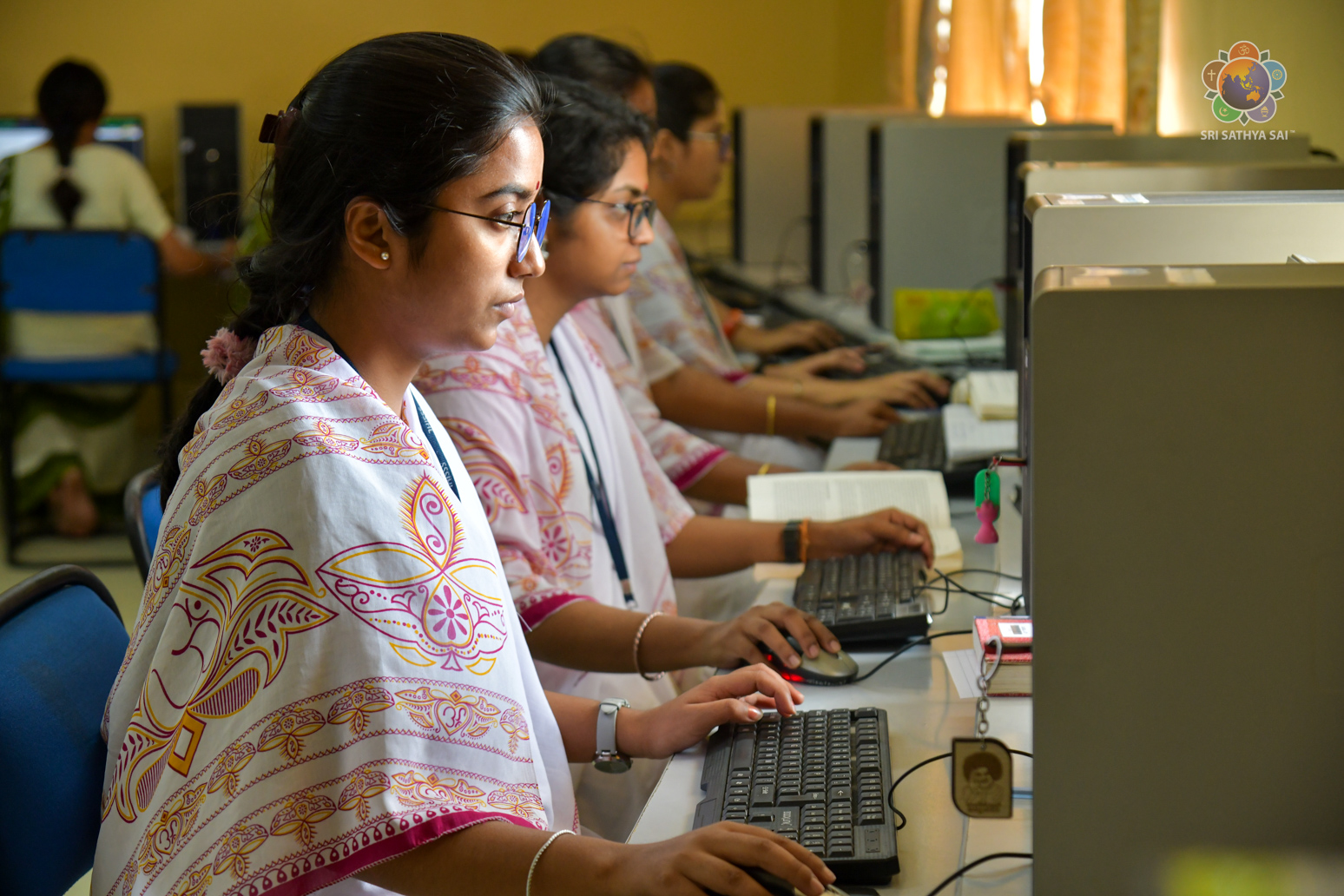
The programme is designed to provide students with a solid foundation in mathematical theory and practical problem-solving skills, covering a wide range of topics. These include calculus, linear algebra, abstract algebra, complex analysis, and numerical analysis, as well as software laboratory courses in Python programming, C programming, and data structures in C.
The programme emphasizes analytical thinking and logical reasoning. It guides students into advanced areas such as abstract algebra and real analysis, fostering a deeper understanding of mathematical structures.
In the first year (Semesters 1 and 2), students are offered courses in Physics and Chemistry alongside Mathematics courses. The curriculum often incorporates real-world applications, enabling students to apply mathematical concepts to industry-specific challenges.
In Year 4, students who achieve a CGPA of 7.5 or higher at the end of the 6th semester are eligible to undertake a research project in their chosen area of specialisation. This research endeavour gives students the opportunity to delve deeper into a specific topic within their field of study, fostering the development of the critical research skills essential for academic and professional growth.
Overall, the B.S. in Mathematics programme equips students with the knowledge and skills to appreciate the elegance of mathematics and tackle complex challenges in both theoretical and applied contexts.
It provides graduates with an excellent foundation for a career in government or industry (e.g., teaching, Finance and Management, Actuarial Sciences, IT, Data Analysis, etc.) and a particularly strong foundation for advanced study in science, engineering, and finance.
Depending on their performance, students can also continue their studies at SSSIHL and pursue the M.Sc. in Mathematics. They can also take national eligibility tests such as CSIR-NET, JEST, NBHM, etc.
Specialization
In Years 3 and 4 (Semesters 5-8), students will choose three electives (see the list of Courses) to pursue a specialization in either one of the following streams:
- Applied Mathematics
- Artificial Intelligence
- Industrial Mathematics
- Theoretical Computer Science
- Mathematical Biology
- Actuarial Science
MINOR
Additionally, students can pursue a minor degree in one of the following subjects:
- Data Science
- Computer Science
- Actuarial Science
- Physics
- Chemistry
These will be undertaken in Years 2 and 3 (Semesters 3 to 6) and will carry a total of 16 credits.
The student then gets awarded a minor degree in that subject.
B.S. (Hons.) in Mathematics
For students who complete a 4-year (8-semester) programme of study.
B.S. (Hons. with Research) with Mathematics
For students who secure a CGPA of 7.5 or more after the first six semesters (3 years of study) and opt to pursue research during the fourth year.
Entry & Exit options as per NEP 2020 Policy.
Further Academic Options at SSSIHL
Note: Programmes are subject to change at any time without prior notice
Following their 4-year undergraduate degree, successful graduates have the following options if they choose to continue their studies at SSSIHL:
M.S. programme (1-year) – 2027 onwards
For students who complete a 4-year B.S. (Hons.) with CGPA of 7.5 or more or B.S. (Hons. with Research) in Mathematics
Ph.D. programme
For students who complete a 4-year B.S. (Hons. with Research) in Mathematics
M.B.A. programme
For students who complete a 3-year B.Sc. or 4-year B.S. (Hons.) / B.S. (Hons. with Research) in Mathematics
- 10+2 years of schooling from a recognized board (CBSE or equivalent) with Mathematics, Physics and Chemistry as core subjects.
- Either passed or appeared for Final exams at XII level before Admissions. If not appeared for XII Standard exams, X and XI Standard marks will be considered
- Consistent academic performance of 60% aggregate marks in X and/or XII Standard
- Age: Preferably below 19 years as of 30th June in the year of admission
YEAR 1
Semester 1
Mathematics: Differential Calculus
Physics: Analog and Digital Electronics
Chemistry: Principles of Structure and Bonding
Practical: Python Programming – I
Awareness Course I: Sai Education for Transformation (Based on Bhagawan Baba’s Life and Teachings)
Semester 2
Mathematics: Integral Calculus
Physics: Introductory Mechanics
Chemistry: Equilibria in Chemistry
Practical: Python Programming – II
Awareness Course II: Unity of Religions
YEAR 2
Semester 3
Real Analysis – I
Linear Algebra – I
Practical: Skill Enhancement Course
Minor Course
Awareness Course III: Study of Classics I – Ramakatha Rasavahini
Semester 4
Real Analysis – II
Algebraic Structures – I
Ordinary Differential Equations
Practical: Skill Enhancement Course
Minor Course
Awareness Course IV: Study of Classics II – Bhagavatha Vahini
YEAR 3
Semester 5
Complex Analysis
Metric Spaces
Optimization Techniques
Specialization Elective – I
Practical: Skill Enhancement Course
Minor Course
Awareness Course V: Ethos and Values for the Changing World
Semester 6
Methods of Differential Equations
Numerical Analysis
Linear Algebra – II
Specialization Elective – II
Internship
Minor Course
Awareness Course VI: Life and its Quest
YEAR 4
Semester 7
B.S. (Hons.) Courses:
Algebraic Structures – II
Specialization Elective – III
Elective – IV
Research Methodology
Elective – V
Awareness Course VII: Education for Life
B.S. (Hons. with Research) Courses:
Algebraic Structures – II
Specialization Elective – III
Differential Geometry
Research Methodology
Project
Awareness Course VII: Education for Life
Semester 8
B.S. (Hons.) Courses:
Mathematical Modelling
Elective – VI
Elective – VII
Elective – VIII
Awareness Course VIII: God, Society and Man
B.S. (Hons. with Research) Courses:
Mathematical Modelling
Elective – VI
Project
Awareness Course VIII: God, Society and Man
SPECIALIZATION ELECTIVES
In Year 4, students must choose all three specialization electives from any one of the following streams:
Analysis and Applications
- Number Theory
- Topology
- Theory of Ordinary
- Differential Equations
- Mathematics for Image Processing
- Advanced Real Analysis
- Theory of Partial Differential Equations
- Functional Analysis
- Measure Theory
Artificial Intelligence
- Artificial Intelligence
- Data Mining and Machine Learning
- Deep Learning
- Natural Language Processing
Industrial Mathematics
- Probability and Statistics
- Graph Theory
- Fuzzy Sets
- Operations Research
- Fluid dynamics
- Mathematical Ecology
- Applied Statistics
- Applied Cryptography
- Techniques in Applied Mathematics
- Combinatorics
Theoretical Computer Science
- Discrete Mathematics
- Mathematical Logic for Computer Science
- Mathematics for Image Processing
- Formal Language and Automata Theory
- Theory of Computation
- Compiler Design
Mathematical Biology
- Mathematical Ecology
- Mathematical Epidemiology
- Dynamical Systems
- Advanced Dynamical Systems
- Stochastic Modelling
- Deterministic Optimal Control Theory