

Undergraduate Programme
For Women & Men
Duration: 4 Years
Physics is the cornerstone of the natural sciences, underpinning many other disciplines, including chemistry, biology, and astronomy. It spans the universe, from the vastness of galaxies to the minuteness of subatomic particles. Whether examining the laws governing the cosmos, the behaviour of superconductors, or the resonant sound of a sitar, physics delves into the intricate workings of our world. Its discoveries have paved the way for groundbreaking technological innovations and continue to play a pivotal role in advancing various scientific fields.
Physics also contributes significantly to the development of key technologies in medical imaging, nanotechnology, and quantum computing. Its role in addressing global challenges – such as energy production, environmental sustainability, climate change, and public health – cannot be overstated, and its impact on society is profound.
UNIQUENESS OF THIS PROGRAMME
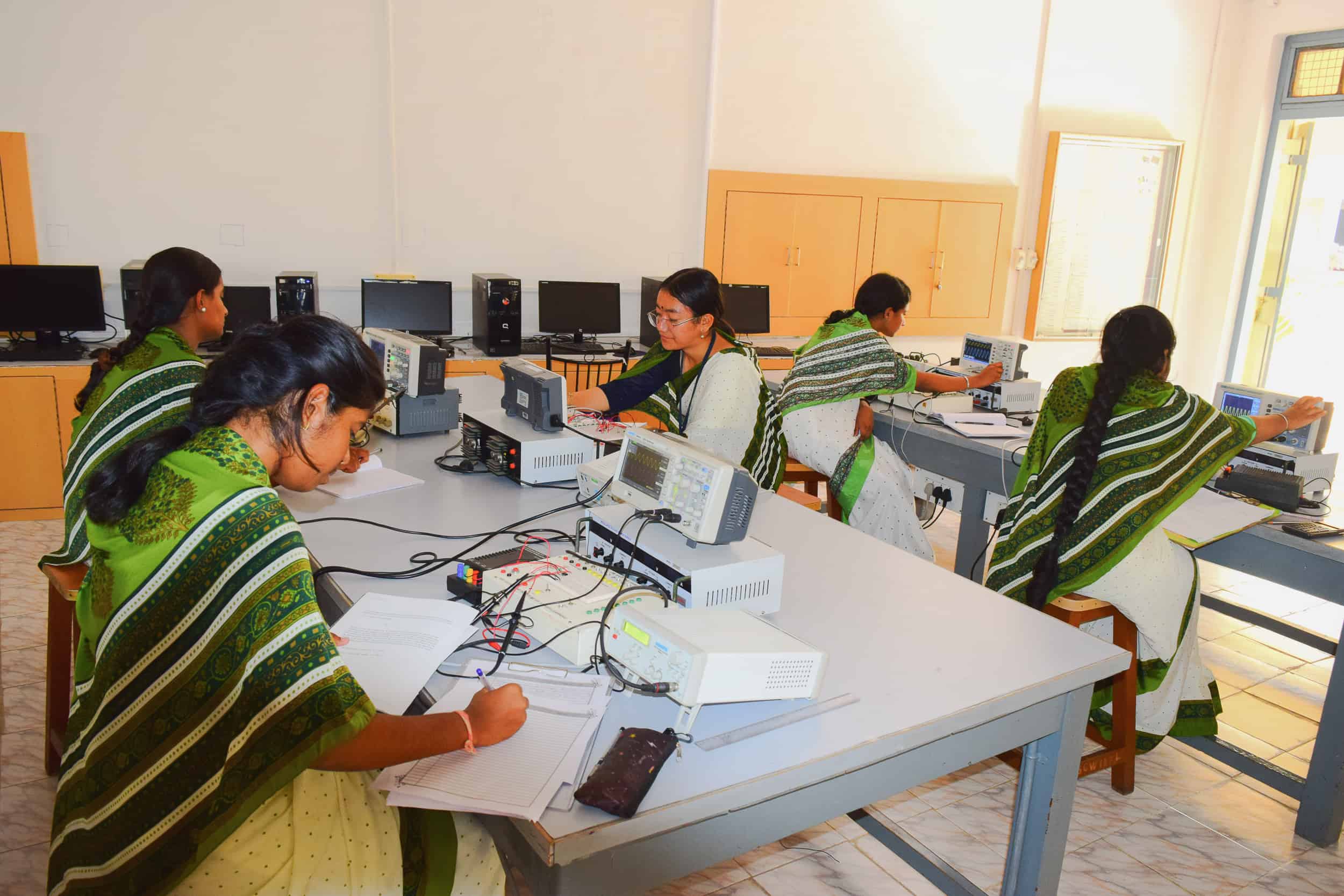
The undergraduate programme – B.S. (Hons./Hons. with Research) – is designed to provide a solid foundation in core physics principles, forming the basis for cutting-edge scientific advancements. The curriculum combines a strong theoretical and experimental approach with hands-on laboratory work, alongside courses in advanced topics and computational physics.
What distinguishes this programme is its unique integration of classical physics education with modern areas of specialization. While many programmes focus primarily on theoretical or experimental physics, this curriculum provides students with essential physics knowledge, a glimpse into emerging fields, and the computational skills necessary to tackle real-world problems.
Additionally, students will gain expertise in computational methods, simulations, and programming, ensuring a comprehensive and forward-thinking education at the bachelor’s level.
In the first two semesters, students are offered courses in Mathematics and Chemistry, in addition to Physics. The eight-semester programme provides in-depth knowledge of various topics in physics through 18 theory courses and 11 laboratory courses. This allows for better assimilation of theoretical concepts.
Specializations
In Year 4 (Semesters 7 and 8), B.S. (Hons.) students have the opportunity to tailor their programme by choosing a specialization (via two electives and a corresponding laboratory course) in any one of the following two streams (see the list of Courses):
- Photonics
- Functional Materials Science
MINOR
In Years 2 and 3 (Semesters 3-6), students can broaden their academic experience by selecting courses from the following fields to earn a minor degree and complement their major in Physics:
- Data Science
- Artificial Intelligence
- Chemistry
- Mathematics
- Economics
- Biosciences
Upon completing all 16 credits in a chosen field, students will be awarded a minor degree in that subject.
Students will also acquire programming and computing skills through the five skill enhancement courses.
CAREER OPTIONS
The programme equips graduate students with analytical, problem-solving, and quantitative skills that are valuable across sectors, including research and development, academic and educational roles, engineering, data analysis and statistics, technology, environmental science, and more.
B.S. (Hons.) in Physics
For students who complete a 4-year (8-semester) programme of study.
B.S. (Hons. with Research) in Physics
For students who secure a CGPA of 7.5 or more after the first six semesters (3 years of study) and opt to pursue research during the fourth year
Entry & Exit options as per NEP 2020 Policy.
Further Academic Options at SSSIHL
Note: Programmes are subject to change at any time without prior notice
Following their 4-year undergraduate degree, successful graduates have the following options if they choose to continue their studies at SSSIHL:
M.S. programme (1-year) – 2027 onwards
For students who complete a 4-year B.S. (Hons.) with CGPA of 7.5 or more or B.S. (Hons. with Research) in Physics
Ph.D. programme
For students who complete a 4-year B.S. (Hons. with Research) in Physics
M.Tech. in Optoelectronics & Communications programme
For Men students who complete a 4-year B.S. (Hons.) or B.S. (Hons. with Research) in Physics
M.B.A. programme
For students who complete a 3-year B.Sc. or 4-year B.S. (Hons.) / B.S. (Hons. with Research) in Physics
- 10+2 years of schooling from a recognized board (CBSE or equivalent)
- Either passed or appeared for Final exams at XII level before Admissions. If not appeared for XII Standard exams, X and XI Standard marks will be considered
- Consistent academic performance of 60% aggregate marks in X and/or XII Standard
- Age: Preferably below 19 years as of 30th June in the year of admission
YEAR 1
Semester 1
Physics: Analog and Digital Electronics
Physics: Electronics Laboratory
Skill Enhancement Course: Python Programming – I
Mathematics: Differential Calculus
Chemistry: Principles of Structure and Bonding
Chemistry: Laboratory Course in General Chemistry
Awareness Course I: Sai Education for Transformation (Based on Bhagawan Baba’s Life and Teachings)
Semester 2
Physics: Introductory Mechanics
Physics: Mechanics Laboratory
Skill Enhancement Course: Python Programming – II
Mathematics: Integral Calculus
Chemistry: Equilibria in Chemistry
Chemistry: Laboratory Course in Titrimetry and Equilibria
Awareness Course II: Unity of Religions
YEAR 2
Semester 3
Mathematical Physics – I
Electromagnetism
Electromagnetism Laboratory
Computational Techniques in Physics
Computational Physics Laboratory – I
Interdisciplinary Minor
Multidisciplinary Course
Awareness Course III: Study of Classics I – Ramakatha Rasavahini
Semester 4
Mathematical Physics – II
Optics
Optics Laboratory
Thermal Physics
Computational Physics Laboratory – II
Interdisciplinary Minor
Multidisciplinary Course – Indian Knowledge Systems
Awareness Course IV: Study of Classics II – Bhagavatha Vahini
YEAR 3
Semester 5
Mathematical Physics – III
Classical Mechanics – I
Operational Amplifiers and Applications
Operational Amplifiers and Applications Laboratory: Hardware and Circuit Simulation Lab
Modern Physics
Experimental Methods in Physics – I
Minor
Awareness Course V: Eternal Values for the Changing World
Semester 6
Quantum Mechanics – I
Solid State Physics – I
Nuclear and Particle Physics
Statistical Mechanics
Experimental Methods in Physics – II
Minor
Internship
Awareness Course VI: Life and its Quest
YEAR 4
Semester 7
B.S. (Hons.) Courses:
Classical Mechanics – II
Classical Electrodynamics
Quantum Mechanics – II
Elective – I
Specialization Laboratory
Research Methodology
Awareness Course VII: Education for Life
B.S. (Hons. with Research) Courses:
Classical Mechanics – II
Classical Electrodynamics
Quantum Mechanics – II
Elective – I
Specialization Laboratory
Research Methodology
Major Project
Awareness Course VII: Education for Life
Semester 8
B.S. (Hons.) Courses:
Solid State Physics – II
Spectroscopy
Microprocessors
Microprocessors Laboratory
Elective – II
Open Elective
Minor project
Awareness Course VIII: God, Society and Man
B.S. (Hons. with Research) Courses:
Solid State Physics – II
Spectroscopy
Elective – II
Major project
Awareness Course VIII: God, Society and Man
SPECIALIZATION ELECTIVES
Stream 1: Photonics
- Select Topics in Photonics
- Introduction to Fiber Optics and Optical Communications
- Principles of Laser Physics
- Specialization Laboratory – Photonics
Stream 2: Functional Materials Science
- Fundamentals of Materials Science
- Introduction to Nanomaterials and Applications
- Crystal Growth and Thin Films
- Materials Processing and Characterization Lab