
Identifying the Issue
- Airborne bacteria in hospitals and homes can trigger respiratory infections and outbreaks.
- Drug resistant airborne pathogens reduce the effectiveness of routine infection control measures.
Objective of the Research
- To test the reliability of Zeta potential as a physicochemical marker, that can be harnessed to trap and eliminate airborne pathogens.
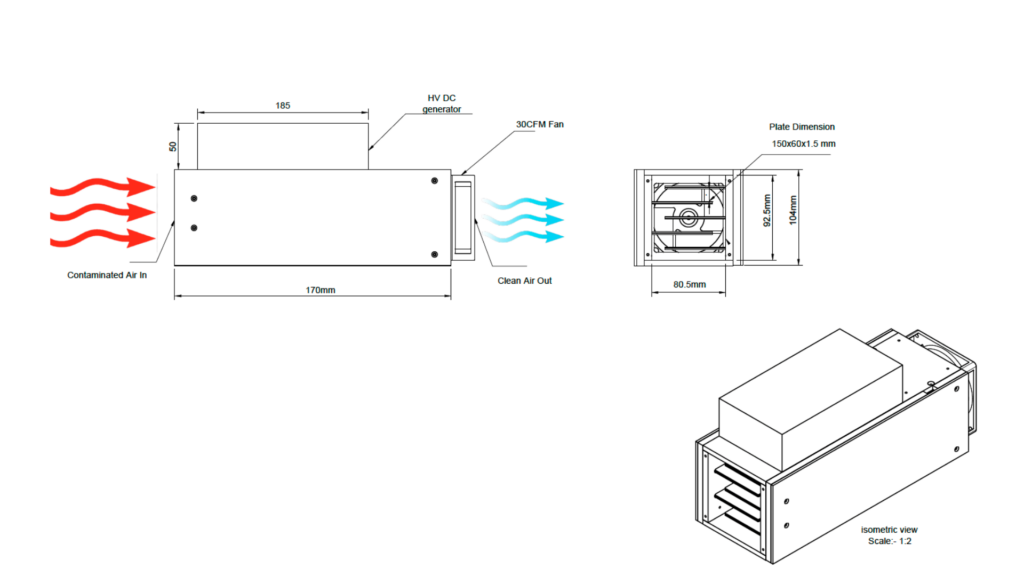
- To validate the efficacy of ZeBox, a novel air decontamination technology developed by Biomoneta, in trapping and killing clinically isolated multi drug resistant respiratory pathogens.
Who should read this?
Infection control teams, hospital administrators, ICU/NICU managers, microbiologists, public health professionals, healthcare facility engineers, and indoor air-quality/medtech stakeholders (India and global healthcare settings).
Solution
ZeBox technology harnesses the power of zeta potential, a universal physicochemical property to trap and kill airborne pathogens. When challenged with clinical isolates in a controlled BSL-2 setting, the device eliminated 99.9999% of airborne bacteria, within five minutes of operation. This efficiency was consistent across multiple species of bacteria. Further, the impact of biofilm formation and the antimicrobial resistance phenotype was found to be negligible on zeta potential and the kill kinetics of ZeBox. The tested isolates included five out of six ESKAPE pathogens and other well-known respiratory pathogens and with varying degrees of antimicrobial resistance. Since ZeBox deploys non-ionizing radiation, it is safe to be operated in presence of humans. These results demonstrate the superiority of ZeBox in eliminating airborne pathogens quickly and efficiently, both in clinical and domestic settings.
Key Features and Benefits
- Rapid reduction of viable airborne drug-resistant bacteria within minutes of operation
- Broad activity across multiple clinically isolated respiratory pathogens with varying resistance phenotypes.
- Uses zeta potential, an universal intrinsic microbial physicochemical property, which is stable across various pathogens
- Non-intrusive, ozone free, continuous-use air decontamination strategy.
Impact
- Smaller footprint compared to other industrial air decontamination technologies coupled with excellent bactericidal efficacy.
- Statistically significant 5-minute reduction of airborne microbial load vs. control condition (paired t-test t = −16.24; p < 0.00001; Cohen’s d = 5.53).
- Strong correlation between Zeta potential and ZeBox kill kinetics observed (Pearson’s r= -0.95, p <0.001)
- Supports infection-control strategies against hospital-associated infections in post-antibiotic and post-pandemic settings
Team
- Arun Sai Kumar Peketi: (https://www.linkedin.com/in/arun-sai-kumar-peketi-16664134/ )
- SVL Sai Kushal Kumar: (https://www.linkedin.com/in/kushal-solleti-b91648136/ )
- Balaji Veeraraghavan (https://www.researchgate.net/profile/Balaji-Veeraraghavan )
- Jayaprada Rangineni (https://www.researchgate.net/profile/Rangineni-Jayaprada )
- Kennedy P Kumar (https://www.researchgate.net/profile/Kennedy-Kumar )
- Eswarappa Pradeep Bulagonda (http://linkedin.com/in/pradeepbulagonda/)
The research team is thankful to Dr. Arindam Ghatak (https://www.linkedin.com/in/arindamghatak/ ) and Dr. Santanu Datta (https://www.linkedin.com/in/santanu-datta-966a52118/ ) of Biomoneta (https://www.linkedin.com/company/biomoneta/posts/?feedView=all) for providing access to the ZeBox Instrument.
Title of paper: “Leveraging zeta potential as a surface charge metric for trapping and killing of airborne bacteria.”
Read Paper Here: https://www.nature.com/articles/s41598-026-38958-x